
Start here · Guide 1 of 12
What is Stoicism? A beginner’s guide to the philosophy
Stoicism is an ancient philosophy of how to live well: focus on what you can control, treat character as the only true good, and meet whatever happens with calm and courage. Where it came from, what it teaches, and where to start.
Stoicism is a philosophy of how to live. It began in Athens around 300 BCE, became one of the most influential philosophies of the Roman world, and has had a remarkable revival in our own time. At its heart are a few ideas that are simple to state and hard to live by:
- Some things are up to us and some are not. Put your effort into the first and meet the second with acceptance.
- Only character is truly good. Wealth, health and reputation are useful but do not decide whether a life goes well.
- We are disturbed less by events than by our judgments about them, and judgments can be changed.
- Philosophy is something you practise, not just something you study.
Where Stoicism came from
The school was founded by Zeno of Citium, who taught in a painted colonnade in the Athenian marketplace, the stoa poikilê, which gave the Stoics their name.1 Seneca, writing three centuries later, tells a story about how Zeno took losing everything:
Zeno, the chief of our school, when he heard the news of a shipwreck, in which all his property had been lost, remarked, ‘Fortune bids me follow philosophy in lighter marching order.’
Almost all the writings of the early Stoics are lost. What survives in full comes from the Roman Stoics, whose works you can read on this site:
- Seneca, statesman and adviser to the emperor Nero, whose letters and essays are the most readable introduction to Stoic ethics.1
- Musonius Rufus, a teacher in Rome whose greatest student was Epictetus.2
- Epictetus, a former slave who became one of the most influential teachers of his day.1
- Marcus Aurelius, Roman emperor from 161 to 180 CE, whose private notebook, the Meditations, was deeply shaped by Epictetus.1
For the full story, see a short history of the Stoics.
What Stoics believe
What is up to us
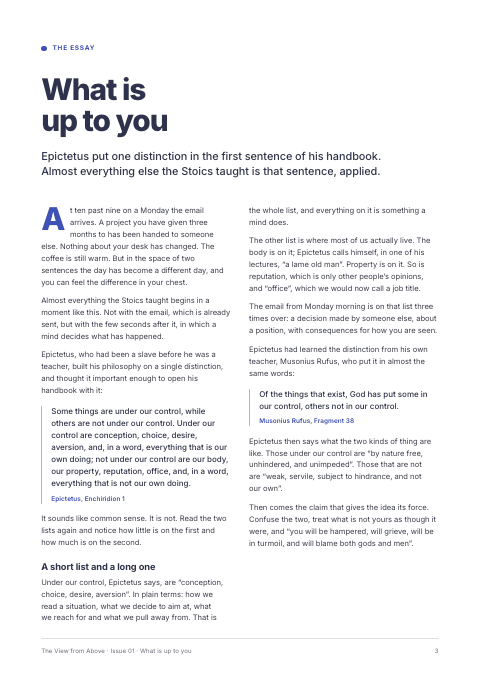
Epictetus opens his handbook of Stoic practice with the idea everything else depends on:
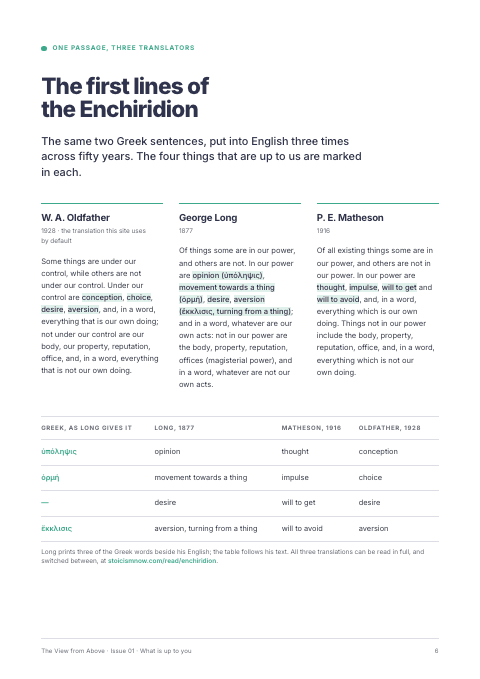
Some things are under our control, while others are not under our control.
Our judgments, choices and actions are ours; our bodies, possessions, reputation and the rest of the world are not. Much of Stoic practice is learning to act fully on the first while letting go of the second. See the dichotomy of control.
Judgments, not things
Epictetus again, in the most quoted line in Stoicism:
It is not the things themselves that disturb men, but their judgements about these things.
This is why Stoicism is so often compared to modern cognitive therapy, whose founders acknowledged the Stoics as their philosophical ancestors.3 See Stoicism and modern therapy.
Virtue is the only good
The Stoics held that the only thing truly good is virtue, meaning wisdom, justice, courage and moderation. Everything else is “indifferent”: some things, like health, are reasonable to prefer, but none of them is needed for a good life.1 Seneca:
Virtue itself is therefore the only good; she marches proudly between the two extremes of fortune, with great scorn for both.
See the four virtues.
Living according to nature
The Stoics described the goal of life as living “in agreement with nature”, meaning both our own nature as reasoning, social beings and the order of the world as a whole.1 Two things follow from it.
The first is a duty to other people. If reason is what makes us human, then everyone who shares it belongs to a single community: the Stoics held that all human beings are citizens of one universal city.1 Marcus Aurelius, who ruled most of the known one, put it like this:
But my nature is rational and social; and my city and country, so far as I am Antoninus, is Rome, but so far as I am a man, it is the world.
The second is acceptance. If the world is an ordered whole and we are parts of it, then what happens to us is not something to resent. See amor fati.
Philosophy as a way of life
For the Stoics, a philosophy that did not change how you lived was not worth much. Musonius Rufus puts it plainly:
For manifestly the study of philosophy is nothing else than to search out by reason what is right and proper and by deeds to put it into practice.
Seneca makes the same point in the image of a student who should leave every lesson a little better:
He who studies with a philosopher should take away with him some one good thing every day: he should daily return home a sounder man, or in the way to become sounder.
That is why so much Stoic writing is practical advice, and why many of their exercises are still used today.
What Stoicism is not
It is not about suppressing emotions. The everyday word “stoic” means keeping a stiff upper lip, but the philosophy is about understanding emotions, not hiding them. The Stoics aimed to be free of emotions based on false judgments, like panic over things that are not truly bad, while valuing good feelings such as joy. See the emotions.
It is not passive resignation. Accepting what you cannot control goes hand in hand with acting energetically on what you can. Seneca was a statesman, Marcus ran an empire, and Musonius was sent into exile by two emperors.2
It is not cold. The Stoics wrote warmly about friendship, family and duty to strangers. Marcus’s notebook opens with a long list of thanks to the people who shaped him.
Where to start
- Read a little. The Enchiridion can be read in an hour. Seneca’s Letters are short and personal; On the Shortness of Life is a single sitting.
- Try one practice. The morning preparation and evening review are the easiest way in.
- Find a quote for what you’re facing. Our quote finder searches every passage by meaning.
Sources
- Marion Durand, Simon Shogry and Dirk Baltzly, “Stoicism”, The Stanford Encyclopedia of Philosophy. plato.stanford.edu.
- William O. Stephens, “Musonius Rufus”, Internet Encyclopedia of Philosophy. iep.utm.edu.
- Aaron T. Beck, A. John Rush, Brian F. Shaw and Gary Emery, Cognitive Therapy of Depression (Guilford Press, 1979), p. 8. PubMed record.
The Stoicism Now magazine · free monthly
The View from Above
Stoicism in depth, every month. Articles, primary sources, and practices you can use, free to read and print.
Latest issue: What is up to you · See inside