
Practices · Guide 10 of 12
Stoic resilience: how the Stoics faced hardship
The Stoics did not hope for an easy life; they trained for a hard one. How Seneca, Epictetus, Musonius Rufus and Marcus Aurelius thought about adversity, and the practices they used to build resilience.
Resilience is not a word the Stoics used, but it may be the thing they are best known for. Their philosophy was shaped by people who had reason to need it. Epictetus had been a slave.1 Musonius Rufus was banished to a barren island.2 Seneca was exiled to Corsica and, years later, compelled to take his own life.3 Marcus Aurelius wrote at least part of the Meditations during his last military campaigns.4
What they developed was not a way of avoiding hardship but a way of meeting it.
Hardship reveals and builds character
The Stoics’ first move is to change what hardship is. Instead of an interruption to your life, it is the test your character has been training for. Epictetus:
It is difficulties that show what men are. Consequently, when a difficulty befalls, remember that God, like a physical trainer, has matched you with a rugged young man.
Seneca wrote a whole essay, On Providence, arguing that difficulty is how the good are trained, and that a life without it leaves a person weak:
Unbroken prosperity cannot bear a single blow; but he who has waged an unceasing strife with his misfortunes has gained a thicker skin by his sufferings, yields to no disaster, and even though he fall yet fights on his knee.
Fire tries gold, misfortune tries brave men.
It is how you bear it
The second move is the dichotomy of control. You cannot choose what happens; you can choose how you respond. Seneca puts it in a single line:
It does not matter what you bear, but how you bear it.
Marcus Aurelius turns this into a rule for himself, in the same passage where he tells himself to be like a headland that the waves break against:
Be like the promontory against which the waves continually break, but it stands firm and tames the fury of the water around it.
Remember too on every occasion which leads thee to vexation to apply this principle; not that this is a misfortune, but that to bear it nobly is good fortune.
You have what you need
A third idea runs through Epictetus: for every difficulty, you already have a capacity that answers it. His advice is to stop and ask which one.
In the case of everything that befalls you, remember to turn to yourself and see what faculty you have to deal with it.
Faced with hard work, he says, you will find endurance; faced with insult, patience. The habit of asking the question is itself the practice.
Resilience is trained, not wished for
The Stoics did not expect calm under pressure to appear on its own. They prepared for it, the way an athlete prepares for a contest. Marcus:
The art of life is more like the wrestler's art than the dancer's, in respect of this, that it should stand ready and firm to meet onsets which are sudden and unexpected.
Musonius Rufus, Epictetus’s teacher, was the most explicit about training. He recommended deliberately getting used to discomfort:
We use the training common to both when we discipline ourselves to cold, heat, thirst, hunger, meagre rations, hard beds, avoidance of pleasures, and patience under suffering.
Seneca adds the mental side: rehearse difficulties in advance, and do it while things are going well.
It is precisely in times of immunity from care that the soul should toughen itself beforehand for occasions of greater stress, and it is while Fortune is kind that it should fortify itself against her violence.
Everyone approaches courageously a danger which he has prepared himself to meet long before, and withstands even hardships if he has previously practised how to meet them.
Both practices are described in our guide to Stoic exercises.
A modern test
The most striking modern example is James Stockdale, a US Navy pilot shot down over North Vietnam and held as a prisoner of war for more than seven years. He had been introduced to Stoicism as a graduate student, and later wrote that the prison camp became his “laboratory of human behavior” for testing Epictetus’s doctrines.5
There is early research evidence too. In a 2025 randomised controlled trial run as part of a PhD at Royal Holloway, University of London, people who followed a two-week online programme of Stoic exercises reported lower depression symptoms than a waitlist group.6 It is a single, not yet peer-reviewed study, but it points the same way.
How to build Stoic resilience
- Expect difficulty. Start the day assuming something will go wrong. It removes the shock, which is often the worst part.
- Ask Epictetus’s question. When trouble arrives: what capacity do I have for dealing with this?
- Separate the event from your response. What happened is fixed. What you do next is not.
- Train in small things. Choose minor discomforts on purpose, so that larger ones are less foreign.
- Look back afterwards. Seneca notes that what was hard to bear becomes something you are glad to have borne:
And that which was bitter to bear is pleasant to have borne; it is natural to rejoice at the ending of one’s ills.
Resilience pairs naturally with amor fati, the practice of accepting and even welcoming what happens. For more passages, see our Stoic quotes on adversity.
Sources
- Marion Durand, Simon Shogry and Dirk Baltzly, “Stoicism”, The Stanford Encyclopedia of Philosophy. plato.stanford.edu.
- William O. Stephens, “Musonius Rufus”, Internet Encyclopedia of Philosophy. iep.utm.edu.
- Katja Vogt, “Seneca”, The Stanford Encyclopedia of Philosophy. plato.stanford.edu.
- Rachana Kamtekar, “Marcus Aurelius”, The Stanford Encyclopedia of Philosophy. plato.stanford.edu.
- James B. Stockdale, Courage Under Fire: Testing Epictetus’s Doctrines in a Laboratory of Human Behavior (Hoover Institution Press, 1993). Hoover Institution.
- Georgina King, Modern Stoicism and Mental Health: A Randomised Controlled Trial (PhD thesis, Royal Holloway, University of London, 2025). 119 participants; not yet published in a peer-reviewed journal. Royal Holloway research portal.
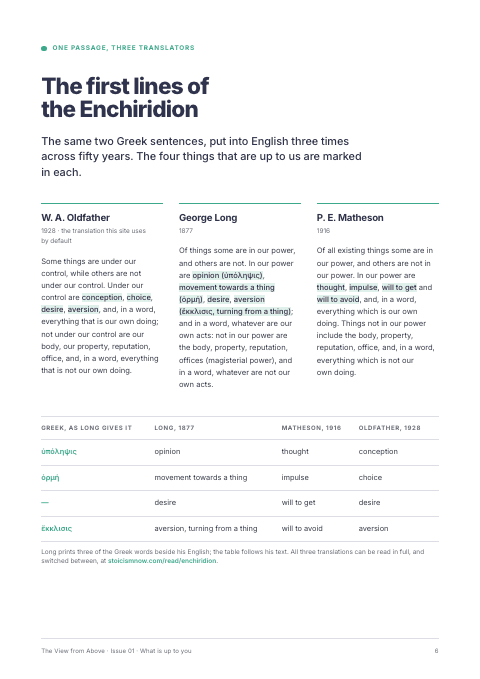
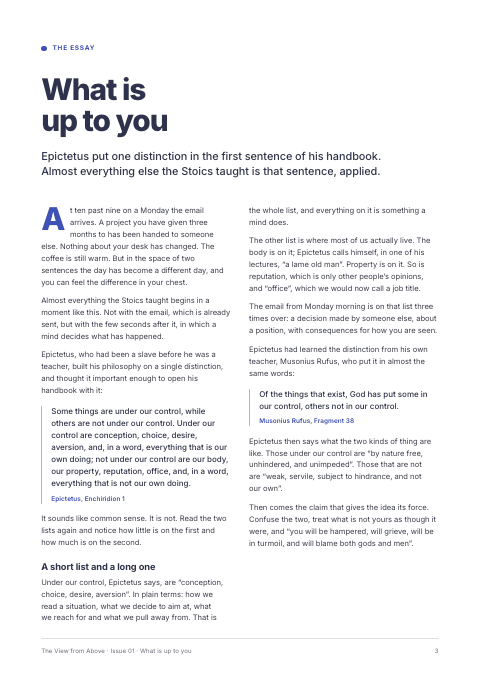
The Stoicism Now magazine · free monthly
The View from Above
Stoicism in depth, every month. Articles, primary sources, and practices you can use, free to read and print.
Latest issue: What is up to you · See inside