
Practices · Guide 9 of 12
Stoic exercises: 9 daily practices from Marcus Aurelius, Seneca and Epictetus
The Stoics treated philosophy as something you practise, not just study. Here are nine of their exercises, with what they actually said about each and how to try it today.
The Stoics did not think philosophy was something you finish learning. You could know every argument in the book and still be anxious, angry and easily flattered. What changed a person was practice: small mental routines repeated until they became habits of thought.
Marcus Aurelius’s Meditations is largely a record of these routines. It was never meant for publication; it is an emperor reminding himself, over and over, how he wanted to see the world. The historian of philosophy Pierre Hadot called practices like these “spiritual exercises”, and the name stuck.1
Below are nine of them. None needs special equipment or much time. Most take a few minutes; a couple take a few days.
1. Prepare for the day in the morning
Before the day starts, think through what it is likely to bring, especially the people who will test your patience. The point is not pessimism but readiness: if you expect some rudeness, it loses its power to surprise and provoke you.
Begin the morning by saying to thyself, I shall meet with the busybody, the ungrateful, arrogant, deceitful, envious, unsocial. All these things happen to them by reason of their ignorance of what is good and evil.
Marcus goes on to remind himself that these people are his kin, and that “we are made for co-operation”. The exercise ends not in contempt but in resolve.
Try it: over your first coffee, name one or two situations today that are likely to irritate you. Decide now how you want to respond.
2. Review the day in the evening
The evening review is the morning preparation in reverse. Seneca describes doing it daily: going back over the day, noting where he acted well and where he fell short, without excuses and without self-punishment.
I shall keep watching myself continually, and—a most useful habit—shall review each day. For this is what makes us wicked: that no one of us looks back over his own life.
In his essay On Anger he credits the habit to an earlier philosopher, Sextius:
It was the custom of Sextius when the day was over, and he had betaken himself to rest, to inquire of his spirit: ‘What bad habit of yours have you cured to-day? what vice have you checked? in what respect are you better?’
Try it: before bed, write three short lines: what went well, what went badly, and what you would do differently.
3. Sort what is up to you from what is not
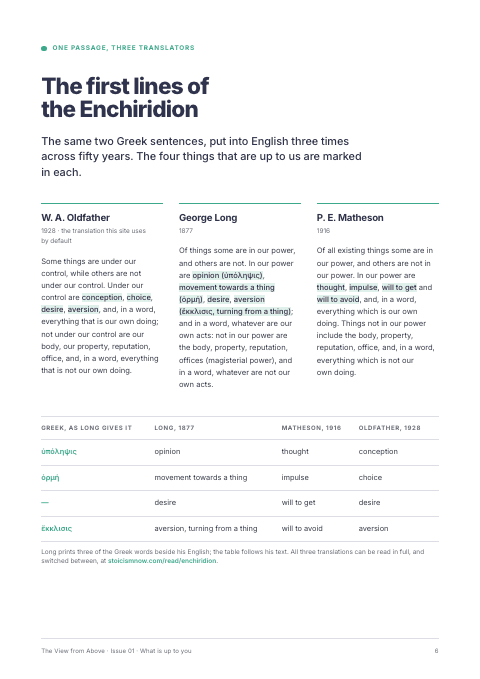
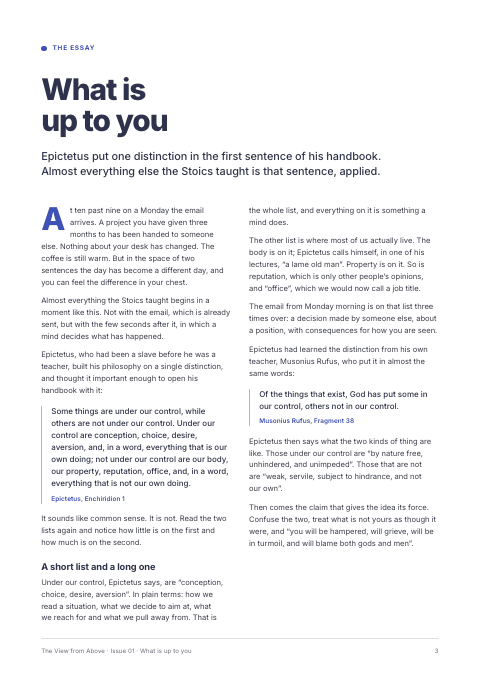
This is the foundation of the rest, and the first line of Epictetus’s Enchiridion. Some things are in your power: your judgments, your intentions, how you act. Most things are not: other people, the past, your reputation, the weather. Distress usually comes from treating the second kind as if it were the first.
If thou art pained by any external thing, it is not this thing that disturbs thee, but thy own judgment about it. And it is in thy power to wipe out this judgment now.
Try it: when something is bothering you, split it into two lists: the parts you control and the parts you don’t. Put all your effort into the first list. Read more in the dichotomy of control.
4. Rehearse misfortune in advance
This is often known by its Latin name, praemeditatio malorum, the premeditation of evils. You calmly imagine things going wrong: losing a job, an illness, a plan collapsing. It sounds grim, but its effect is the opposite. Fear feeds on vagueness; looked at directly, most feared outcomes turn out to be survivable.
if you would put off all worry, assume that what you fear may happen will certainly happen in any event; whatever the trouble may be, measure it in your own mind, and estimate the amount of your fear. You will thus understand that what you fear is either insignificant or short-lived.
Try it: pick one thing you are worried about. Imagine it has happened. What would you actually do next?
5. Practise a little voluntary discomfort
Seneca advised Lucilius to set aside a few days now and then to live on the plainest food and clothing, as if poor, and to ask himself whether this was really what he had been afraid of.
Set aside a certain number of days, during which you shall be content with the scantiest and cheapest fare, with coarse and rough dress, saying to yourself the while: ‘Is this the condition that I feared?’
The aim is not hardship for its own sake. It is to learn, from experience rather than argument, that you need far less than you think, so that the fear of losing comforts loosens its grip.
Try it: a cold shower, a day of simple meals, or a walk instead of a taxi. Notice how quickly you adjust.
6. Take the view from above
When a problem feels enormous, zoom out. Picture your city from above, then your country, then the whole earth with its billions of lives and its long history. Your problem is still real, but it takes up its proper, smaller place.
Look down from above on the countless herds of men and their countless solemnities, and the infinitely varied voyagings in storms and calms, and the differences among those who are born, who live together, and die.
Modern psychology has studied something similar under the name self-distancing. People tend to reason more wisely about other people’s problems than their own, and experiments find that simply viewing your own problem from a distance, as an observer would, closes much of that gap.23
Try it: next time you are stewing over something, spend two minutes deliberately widening the frame.
7. Describe things as they are
Marcus had a habit of stripping things of their glamour by describing them in plain physical terms. Fine wine is “a little grape-juice”; a purple robe is sheep’s wool dyed with shellfish blood.
When we have meat before us and such eatables, we receive the impression that this is the dead body of a fish, and this the dead body of a bird or of a pig; and again, that this Falernian is only a little grape-juice…
The same technique works on anything that has too strong a hold on you: a status symbol, an insult, a craving. Describing it accurately takes away the extra meaning you have attached to it.
Epictetus used it to prepare for loss, starting with the smallest things:
If you are fond of a jug, say, "I am fond of a jug"; for when it is broken you will not be disturbed.
Try it: take something you want too much, or something that has upset you, and describe it in the flattest terms you can.
8. Remember that you will die
Keeping death in view, memento mori, was for the Stoics a way to stop postponing life, not a way to be gloomy. If you might not have long, you stop wasting time on what doesn’t matter.
Do not act as if thou wert going to live ten thousand years. Death hangs over thee. While thou livest, while it is in thy power, be good.
Epictetus gave his students the same advice:
Keep before your eyes day by day death and exile, and everything that seems terrible, but most of all death; and then you will never have any abject thought, nor will you yearn for anything beyond measure.
There is some modern support for the idea. In one study, people asked to reflect vividly on their own death reported more gratitude afterwards than people in a control group.4
Try it: ask of what you are about to do: if this were one of my last days, would I spend it like this? More in memento mori.
9. Take one thought for the day
Seneca’s advice on reading was not to consume as much as possible but to choose one idea each day and really digest it.
Each day acquire something that will fortify you against poverty, against death, indeed against other misfortunes as well; and after you have run over many thoughts, select one to be thoroughly digested that day.
Try it: pick a single passage in the morning, from the Meditations or the Letters, and come back to it once or twice during the day. Our quote finder can help you find one that fits what you are dealing with.
Where to start
You don’t need all nine. A good place to start is three: the morning preparation, the evening review, and sorting what is and isn’t in your control. Do those daily for a couple of weeks before adding anything else.
The research on Stoic practice as a whole is still young, but early results are encouraging. In a 2025 randomised controlled trial run as part of a PhD at Royal Holloway, University of London, people who followed a two-week online programme of Stoic exercises reported lower depression symptoms than a waitlist group, with anxiety improving by the one-month follow-up.5 As Marcus kept reminding himself, the point is to do it, not to admire the idea of doing it.
No longer talk at all about the kind of man that a good man ought to be, but be such.
Sources
- Pierre Hadot, Philosophy as a Way of Life: Spiritual Exercises from Socrates to Foucault, ed. Arnold I. Davidson, trans. Michael Chase (Blackwell, 1995). Publisher’s page.
- Igor Grossmann and Ethan Kross, “Exploring Solomon’s Paradox: Self-Distancing Eliminates the Self-Other Asymmetry in Wise Reasoning About Close Relationships in Younger and Older Adults”, Psychological Science 25, no. 8 (2014): 1571–1580. doi:10.1177/0956797614535400.
- Ethan Kross and Ozlem Ayduk, “Self-Distancing: Theory, Research, and Current Directions”, Advances in Experimental Social Psychology 55 (2017): 81–136. ScienceDirect.
- Araceli Frias, Philip C. Watkins, Amy C. Webber and Jeffrey J. Froh, “Death and Gratitude: Death Reflection Enhances Gratitude”, The Journal of Positive Psychology 6, no. 2 (2011): 154–162. doi:10.1080/17439760.2011.558848.
- Georgina King, Modern Stoicism and Mental Health: A Randomised Controlled Trial (PhD thesis, Royal Holloway, University of London, 2025). 119 participants; not yet published in a peer-reviewed journal. Royal Holloway research portal.

The Stoicism Now magazine · free monthly
The View from Above
Stoicism in depth, every month. Articles, primary sources, and practices you can use, free to read and print.
Latest issue: What is up to you · See inside