
Stoicism today · Guide 11 of 12
Stoicism and modern therapy: how CBT grew from Stoic roots
Cognitive behavioural therapy (CBT) was built on a Stoic idea, that our distress comes from our judgments rather than from events. What the two share, where they differ, and what the research says.
Cognitive behavioural therapy, or CBT, is one of the most widely used and best-studied forms of psychotherapy. Its central idea is nearly two thousand years old. Epictetus stated it in his handbook:
It is not the things themselves that disturb men, but their judgements about these things.
The founders of CBT knew this, and said so.
This guide is about ideas, not treatment. If you are struggling with your mental health, please speak to a doctor or a qualified therapist.
What the founders said
Two people are usually credited with founding the cognitive therapies. Albert Ellis developed rational emotive behaviour therapy (REBT) in the 1950s. In his first major book he wrote that its central principle, that people are affected less by events than by their thinking about them, was originally discovered and stated by the ancient Stoic philosophers, and he illustrated it with the line from Epictetus above.1
Aaron Beck, who developed cognitive therapy for depression, made the same acknowledgement. He and his colleagues wrote that the philosophical origins of cognitive therapy can be traced back to the Stoic philosophers, naming Zeno, Chrysippus, Cicero, Seneca, Epictetus and Marcus Aurelius.2
What Stoicism and CBT share
Thoughts shape feelings
Both hold that an emotion follows from an interpretation. Change the interpretation and the emotion changes. Marcus Aurelius:
If thou art pained by any external thing, it is not this thing that disturbs thee, but thy own judgment about it. And it is in thy power to wipe out this judgment now.
Psychologists call this skill cognitive reappraisal. People who habitually reappraise upsetting events, rather than suppressing their feelings, tend to report better well-being.3
Stepping back from a thought
CBT teaches people to notice a thought as a thought, rather than as a fact. Epictetus taught the same move, and even gave the words to use:
Make it, therefore, your study at the very outset to say to every harsh external impression, "You are an external impression and not at all what you appear to be."
Facing fears on purpose
Therapists often ask anxious clients to imagine the feared outcome in detail, and find it is more survivable than it seemed. Seneca recommends exactly this:
if you would put off all worry, assume that what you fear may happen will certainly happen in any event; whatever the trouble may be, measure it in your own mind, and estimate the amount of your fear. You will thus understand that what you fear is either insignificant or short-lived.
His advice to practise living on very little, and then to ask “Is this the condition that I feared?”, works the same way as a behavioural experiment: you test a fear against reality.
Daily self-monitoring
Keeping a record of situations, thoughts and reactions is a standard CBT exercise. The Stoic evening review is an older version of it. Seneca describes the practice and says he does it himself:
I make use of this privilege, and daily plead my cause before myself: when the lamp is taken out of my sight, and my wife, who knows my habit, has ceased to talk, I pass the whole day in review before myself, and repeat all that I have said and done
Seeing your situation from outside
The Stoic “view from above” asks you to look at your troubles as an observer would. Research on self-distancing finds that people reason more wisely about their own problems when they step back from them in this way.4
Where they differ
The similarities are real, but Stoicism is not simply old-fashioned CBT.
- Therapy or philosophy. CBT is a treatment for specific problems, usually over a limited period. Stoicism is a philosophy for a whole life.
- Values. CBT helps people think more accurately and act on their own goals. Stoicism has a view about what the goal should be: good character, which it calls the only true good. See the four virtues.
- How far the claim goes. A therapist might help someone see that losing a job is not the catastrophe it feels like. The Stoics go further and say that nothing outside your own character is truly bad at all. That is a philosophical position, not a clinical one.
What the research says
There is strong evidence that CBT works for a range of conditions: a review of more than a hundred meta-analyses found the strongest support for anxiety disorders, among others.5 Evidence for Stoic practice itself is much thinner, but it is starting to appear. In a 2025 randomised controlled trial run as part of a PhD at Royal Holloway, University of London, 119 people were assigned either to a two-week online programme of Stoic exercises or to a waiting list. Those who did the exercises reported lower depression symptoms afterwards, and lower anxiety at a one-month follow-up.6 It is one study and has not yet been published in a peer-reviewed journal, so it should be read as encouraging rather than conclusive.
Trying the Stoic techniques
The practices described here are set out step by step in our guide to Stoic exercises, and the Stoic account of feeling is explained in the emotions. For the fullest scholarly treatment of the connection, see Donald Robertson’s book.1
Sources
- Donald Robertson, The Philosophy of Cognitive-Behavioural Therapy (CBT): Stoic Philosophy as Rational and Cognitive Psychotherapy, 2nd ed. (Routledge, 2019). Publisher’s page. Ellis’s remark is from Reason and Emotion in Psychotherapy (1962).
- Aaron T. Beck, A. John Rush, Brian F. Shaw and Gary Emery, Cognitive Therapy of Depression (Guilford Press, 1979), p. 8. PubMed record.
- James J. Gross and Oliver P. John, “Individual Differences in Two Emotion Regulation Processes: Implications for Affect, Relationships, and Well-Being”, Journal of Personality and Social Psychology 85, no. 2 (2003): 348–362. doi:10.1037/0022-3514.85.2.348.
- Igor Grossmann and Ethan Kross, “Exploring Solomon’s Paradox: Self-Distancing Eliminates the Self-Other Asymmetry in Wise Reasoning About Close Relationships in Younger and Older Adults”, Psychological Science 25, no. 8 (2014): 1571–1580. doi:10.1177/0956797614535400.
- Stefan G. Hofmann, Anu Asnaani, Imke J. J. Vonk, Alice T. Sawyer and Angela Fang, “The Efficacy of Cognitive Behavioral Therapy: A Review of Meta-analyses”, Cognitive Therapy and Research 36, no. 5 (2012): 427–440. doi:10.1007/s10608-012-9476-1.
- Georgina King, Modern Stoicism and Mental Health: A Randomised Controlled Trial (PhD thesis, Royal Holloway, University of London, 2025). Royal Holloway research portal.
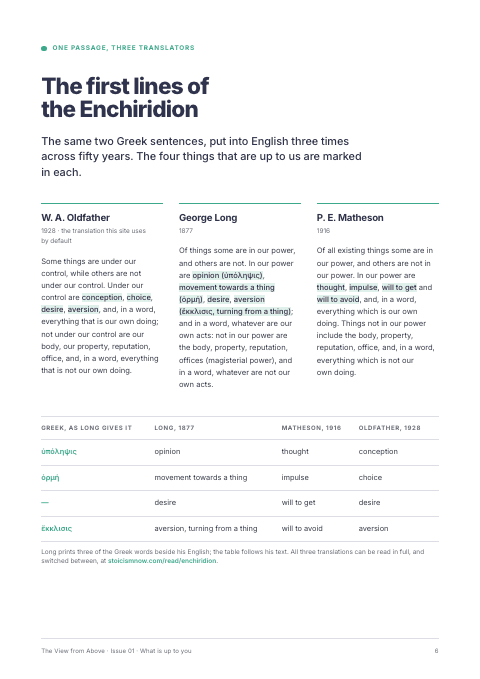
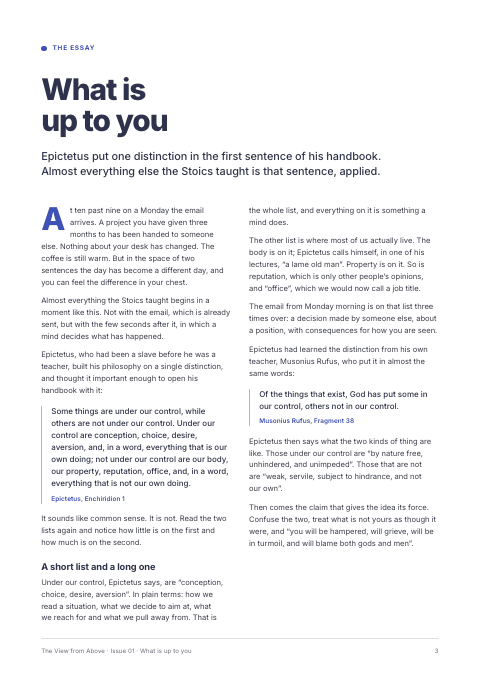
The Stoicism Now magazine · free monthly
The View from Above
Stoicism in depth, every month. Articles, primary sources, and practices you can use, free to read and print.
Latest issue: What is up to you · See inside