
Core ideas · Guide 6 of 12
The Stoics on emotions: not suppression, but understanding
The Stoics are famous for controlling their emotions, but they did not teach people to bottle things up. What they actually said about where emotions come from, which ones to let go of, and which to keep.
In everyday English, “stoic” means enduring pain without showing it. That is not what the Stoics taught. They did not think you should feel things and hide them; they thought most painful emotions rest on mistaken beliefs, and that if you correct the belief, the emotion changes.
This is one of the most misunderstood parts of Stoicism, and one of the most useful.
Emotions come from judgments
The Stoic theory starts from a simple claim: an emotion is not something that just happens to you. It involves a judgment that something good or bad has happened or is about to.1 Epictetus’s version is the most famous:
It is not the things themselves that disturb men, but their judgements about these things.
If someone insults you and you become furious, the Stoics would say the fury depends on a judgment, roughly “I have been seriously harmed, and he deserves to pay”. Remove the judgment and the fury has nothing to stand on.
The early Stoics sorted the troublesome emotions, which they called passions, into four kinds, according to the judgment behind them: distress (something bad is happening), fear (something bad is coming), appetite (something good is coming and I must have it) and pleasure (something good is happening).1 In each case, the Stoics thought the judgment was usually false, because it treats things outside our control as truly good or bad.
First reactions are not the problem
An obvious objection: surely I can’t help flinching, blushing or feeling a jolt of alarm? The Stoics agreed. Seneca, in On Anger, carefully separates the involuntary first reaction from the emotion proper:
Consequently, the bravest of men often turns pale while he is putting on his armour; when the signal for battle is given, the knees of the boldest soldier shake for a moment
These reactions are, he says, “merely impulses of the body”. Nobody is to blame for them, and no amount of philosophy will remove them.1 He then sets out how a passion actually develops, in three steps:
…the first emotion is involuntary, and is, as it were, a preparation for a passion, and a threatening of one. The next is combined with a wish, though not an obstinate one, as, for example, ‘It is my duty to avenge myself, because I have been injured,’ or ‘It is right that this man should be punished, because he has committed a crime.’ The third emotion is already beyond our control, because it overrides reason
The practical lesson is in the second step. Between the first jolt and the full emotion there is a moment where you agree, or don’t, with the thought “I have been wronged and must respond”. That moment is where Stoic practice happens.
The Stoic is not made of stone
The Stoics were often accused of wanting people to feel nothing. Seneca rejects this directly:
I do not say that the wise man does not feel these, for we do not ascribe to him the hardness of stone or iron
On grief he is more nuanced than his reputation suggests. Tears are natural; what he warns against is nursing sorrow or performing it for others.
for I hold that with a wise man some tears fall by consent, others by their own force.
He even admits his own failure. When his friend Annaeus Serenus died, he writes, he wept “so excessively” that he must count himself among those overcome by grief.
The good emotions
Getting rid of the passions was never meant to leave a blank. The Stoics held that a person who judges things correctly still has feelings, but healthy ones, responses to what is genuinely good, such as joy in acting well and in good friends.1 Seneca writes about this joy often:
This joy springs only from the knowledge that you possess the virtues.
But that joy which springs wholly from oneself is leal and sound; it increases and attends us to the last
(Leal is an old word for loyal, or faithful.) The aim is not less feeling but better-founded feeling: affection without possessiveness, caution without panic, joy that does not depend on luck.
Understanding, not suppression
Modern psychology draws a similar line. Researchers distinguish reappraisal, changing how you think about a situation, from suppression, hiding what you feel. In a well-known experiment, people asked to reappraise an upsetting film felt less distress, while people asked to suppress their reactions did not feel better and showed more signs of physical stress.2 The Stoic method is reappraisal. See Stoicism and modern therapy.
How to work with an emotion
- Notice the first jolt and let it pass. A racing heart or a flash of irritation is not a failure. Don’t act on it yet.
- Find the judgment. Ask: what am I telling myself has happened? “She disrespected me.” “This will ruin everything.”
- Test it. Is it true? Is the thing actually bad, or just unwelcome? Is it up to me?
- Delay if the emotion is strong. For anger especially, Seneca’s best advice is simply to wait:
The greatest remedy for anger is delay
- Choose the response. Once the judgment is corrected, decide what a fair and sensible person would do, and do that.
Marcus Aurelius describes the result as a kind of fortress:
Therefore the mind which is free from passions is a citadel, for man has nothing more secure to which he can fly for refuge and for the future be inexpugnable.
For more, see our Stoic quotes on anger and on fear, or read Seneca’s On Anger in full.
Sources
- Marion Durand, Simon Shogry and Dirk Baltzly, “Stoicism”, The Stanford Encyclopedia of Philosophy, §4.7. plato.stanford.edu.
- James J. Gross, “Antecedent- and Response-Focused Emotion Regulation: Divergent Consequences for Experience, Expression, and Physiology”, Journal of Personality and Social Psychology 74, no. 1 (1998): 224–237. doi:10.1037/0022-3514.74.1.224.
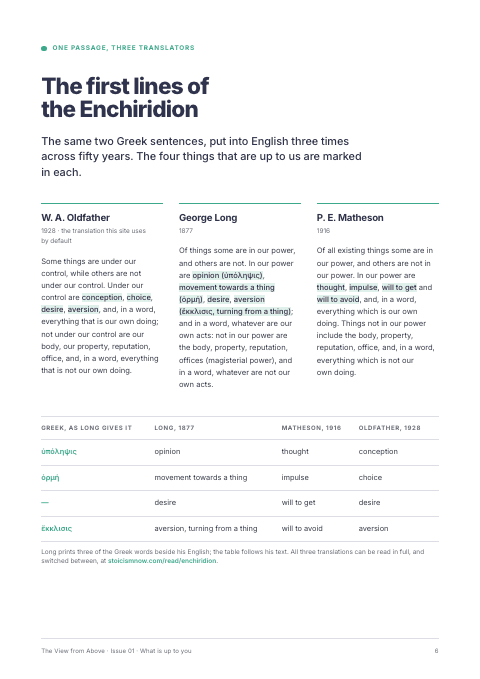
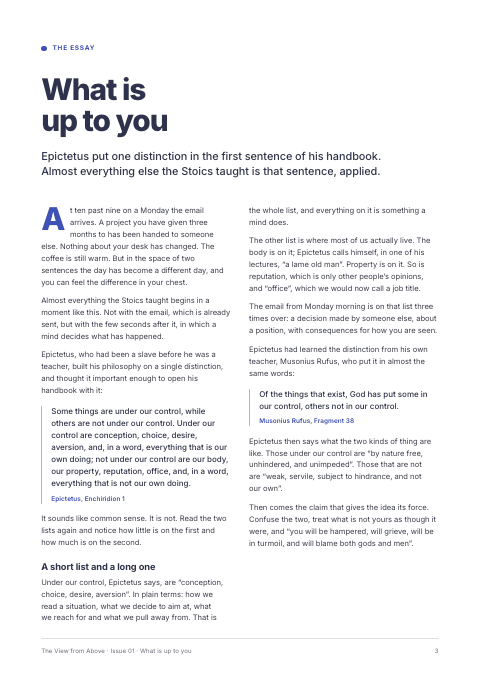
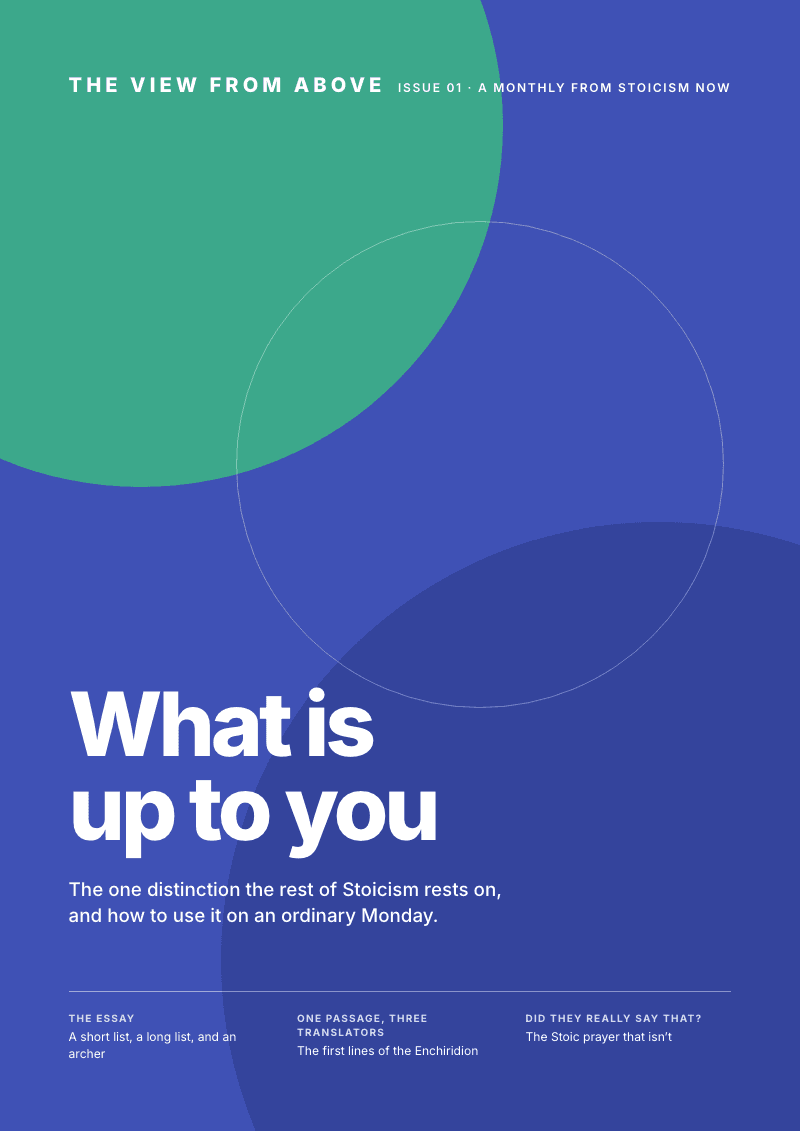
The Stoicism Now magazine · free monthly
The View from Above
Stoicism in depth, every month. Articles, primary sources, and practices you can use, free to read and print.
Latest issue: What is up to you · See inside