
Stoicism today · Guide 12 of 12
Stoicism in modern life: work, attention and relationships
The Stoics never saw an open-plan office or a smartphone, but they wrote a great deal about ambition, distraction, other people’s opinions and difficult relatives. How their advice applies to work, to attention in a noisy world, and to the people around us.
The Stoics did not write about email, social media or performance reviews. It would be dishonest to pretend they did. But the problems underneath those things are old: wanting recognition, being pulled in too many directions, caring too much what others think, losing patience with the people closest to us. On all of these they had a lot to say.
Seneca wrote at least one of his letters from lodgings above a public bathhouse, surrounded by noise. Marcus Aurelius ran an empire. Their advice was written for busy people in a crowded, competitive city, which is why so much of it still fits.
At work
Do the job in front of you
Marcus Aurelius did not always want to get out of bed. His note to himself is one of the most quoted lines in the Meditations:
In the morning when thou risest unwillingly, let this thought be present,—I am rising to the work of a human being.
The point is not to love every task. It is that doing your part well is what you are for, and that is reason enough to start.
Stake yourself on effort, not results
Promotions, recognition and other people’s decisions are not up to you. The quality of your work and how you treat people are. Epictetus:
You can be invincible if you never enter a contest in which victory is not under your control.
This is the dichotomy of control applied to a career. Work as well as you can; let the outcome be what it is.
When someone else gets ahead
Epictetus has sharp advice for the moment a colleague is preferred over you. Recognition, he says, has a price, such as flattery or constant attendance on the powerful, and if you were not willing to pay it, you have no grounds to resent the person who was.
You will be unjust, therefore, and insatiable, if, while refusing to pay the price for which such things are bought, you want to obtain them for nothing.
And you kept something in exchange: you did not have to do the flattering.
Taking criticism
Epictetus’s suggestion for dealing with criticism behind your back is disarming:
If someone brings you word that So-and-so is speaking ill of you, do not defend yourself against what has been said, but answer, "Yes, indeed, for he did not know the rest of the faults that attach to me; if he had, these would not have been the only ones he mentioned."
If the criticism is true, there is something to learn. If it is false, it is the critic who is mistaken. Either way there is little to be upset about.
Busy is not the same as useful
Seneca was scathing about people who are always occupied and never get anywhere:
Many men spend their lives in exactly the same fashion, which one may call a state of restless indolence.
His essay On the Shortness of Life is about exactly this: we are not short of time, we give it away.
Attention in a noisy world
Do less, more deeply
The Stoics knew nothing of notifications, but they knew distraction. Marcus:
Do the things external which fall upon thee distract thee? Give thyself time to learn something new and good, and cease to be whirled around.
Seneca’s advice on reading applies to almost anything we consume. Skimming a little of everything leaves you with nothing:
Everywhere means nowhere. When a person spends all his time in foreign travel, he ends by having many acquaintances, but no friends.
His remedy is the one in Stoic exercises: pick one good thing each day and digest it properly.
Other people’s opinions
Much of what makes modern life anxious is an audience. Marcus noticed the oddity of it long before anyone could count followers:
I have often wondered how it is that every man loves himself more than all the rest of men, but yet sets less value on his own opinion of himself than on the opinion of others.
Reputation is one of the things Epictetus lists as not up to us. You can behave well; you cannot control what is said about it.
Choose your company
Seneca worried about what crowds do to character, but he did not recommend hiding from people. He recommended choosing them:
Associate with those who will make a better man of you. Welcome those whom you yourself can improve.
That is a reasonable rule for the voices you let in, in person or otherwise.
The people around us
We are made for each other
The Stoics were not loners. They held that human beings are social by nature and owe each other patience. Marcus:
Men exist for the sake of one another. Teach them then, or bear with them.
Adapt thyself to the things with which thy lot has been cast: and the men among whom thou hast received thy portion, love them, but do it truly [sincerely].
“The men among whom thou hast received thy portion” covers family, colleagues and neighbours: the people you did not choose. The instruction is not to tolerate them but to love them, and to mean it.
Expect people to be difficult
Marcus began his day by reminding himself that he would meet rude, ungrateful and selfish people, and that they act as they do out of ignorance rather than malice. Expecting it takes away the shock, and with it most of the anger. See the emotions.
Friendship and partnership
Seneca’s rule for friendship is to be slow in choosing and then wholehearted:
When friendship is settled, you must trust; before friendship is formed, you must pass judgment.
Musonius Rufus wrote about marriage as a partnership of equals in care:
But in marriage there must be above all perfect companionship and mutual love of husband and wife, both in health and in sickness and under all conditions
When you are angry with someone you love
Seneca’s best advice is the simplest:
The greatest remedy for anger is delay
Say nothing yet. Most of what we regret saying is said in the first minute.
Where to go next
- For daily practices, see Stoic exercises.
- For handling setbacks, see resilience.
- For a passage that fits what you are facing, try the quote finder.
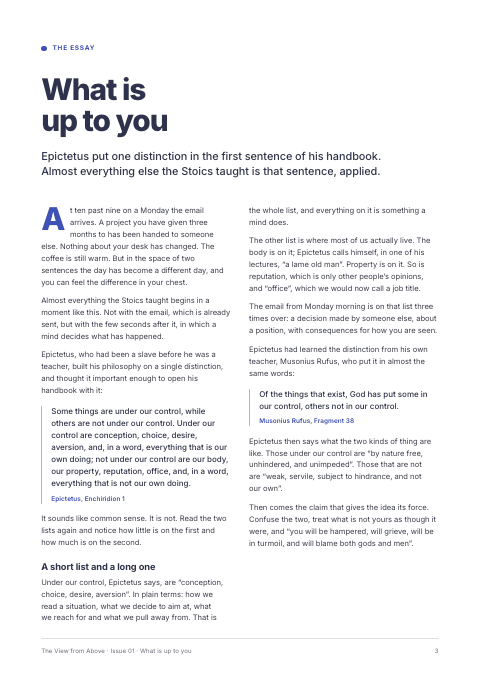

The Stoicism Now magazine · free monthly
The View from Above
Stoicism in depth, every month. Articles, primary sources, and practices you can use, free to read and print.
Latest issue: What is up to you · See inside