
Core ideas · Guide 3 of 12
The dichotomy of control: the idea at the heart of Stoicism
Some things are up to us and some are not. What the Stoics meant by this, what it does and doesn’t imply, and how Epictetus, Marcus Aurelius and Seneca put it into practice.
If Stoicism has one idea everything else hangs on, it is this: some things are up to us, and some things are not. Peace of mind comes from putting your effort and your hopes into the first kind, and meeting the second kind with acceptance.
The name “dichotomy of control” is modern, but the idea is ancient. Its best-known statement opens the Enchiridion (Handbook) of Epictetus, the teacher whose lectures shaped Marcus Aurelius. (Marcus credits his tutor Rusticus with lending him a copy of Epictetus’s discourses, in the first book of the Meditations.)
What is up to us, and what is not
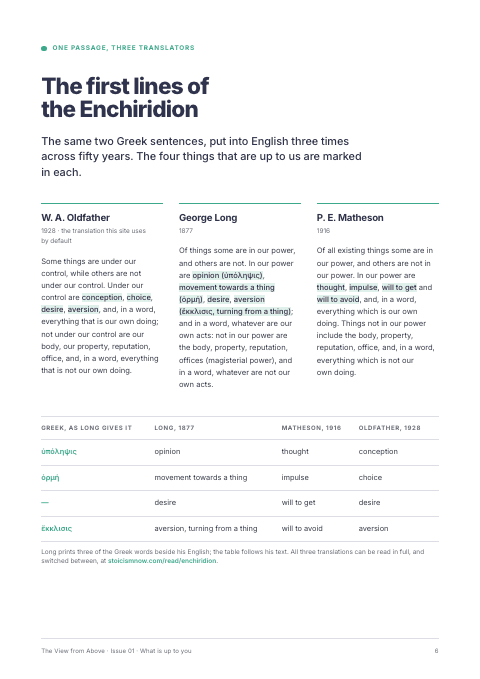
Epictetus draws the line sharply, in the very first lines of the Enchiridion:
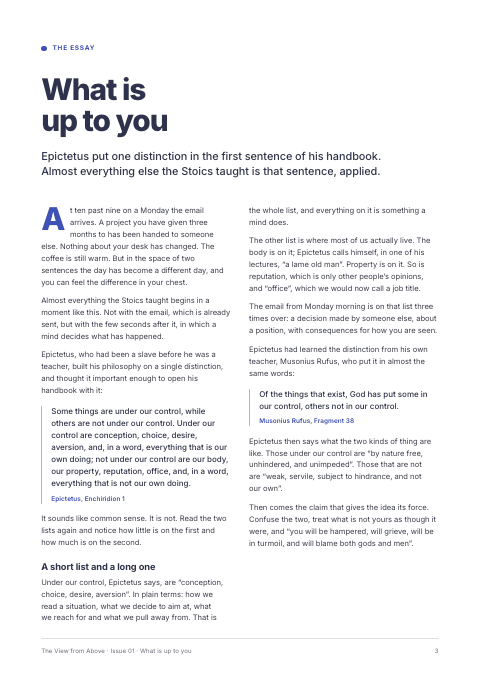
Some things are under our control, while others are not under our control. Under our control are conception, choice, desire, aversion, and, in a word, everything that is our own doing; not under our control are our body, our property, reputation, office, and, in a word, everything that is not our own doing.
In short: what goes on in our own minds and what we choose to do is up to us; our bodies, possessions, reputation, position and everything else in the world outside are not.1 Epictetus had learned the idea from his own teacher, Musonius Rufus, who put it in almost the same words.
Of the things that exist, God has put some in our control, others not in our control.
That second list is longer than most people like to admit. It includes other people’s opinions of you, whether you get the job, whether you stay healthy, whether a plan succeeds. You can influence many of these things, but you do not control them.
What you always have is the first list: how you interpret what happens, and what you do next. Marcus returns to this again and again.
It is in our power to have no opinion about a thing, and not to be disturbed in our soul; for things themselves have no natural power to form our judgments.
Why it matters: we are disturbed by judgments, not things
The practical force of the idea comes from a second claim: that our distress is caused less by events than by what we tell ourselves about them. An insult is a few words; the humiliation comes from the judgment that we have been harmed. Epictetus’s version is the most quoted line in Stoicism:
It is not the things themselves that disturb men, but their judgements about these things.
Marcus says the same thing in his own words:
If thou art pained by any external thing, it is not this thing that disturbs thee, but thy own judgment about it. And it is in thy power to wipe out this judgment now.
One is that things do not touch the soul, for they are external and remain immovable; but our perturbations come only from the opinion which is within.
This is also the insight modern cognitive therapy took from the Stoics. Aaron Beck and his colleagues, in the book that founded cognitive therapy for depression, traced its philosophical origins back to the Stoics, Epictetus among them.2 Psychologists now call the skill cognitive reappraisal, and people who habitually reappraise upsetting events, rather than suppressing their feelings, report better well-being.3 See Stoicism and modern therapy.
It does not mean giving up
The most common misunderstanding is that the dichotomy of control is a counsel of passivity: if outcomes aren’t up to you, why try? The Stoics meant the opposite. You should act, and act well, while holding the outcome lightly.
Seneca puts the division neatly:
And finally, the wise man regards the reason for all his actions, but not the results. The beginning is in our own power; fortune decides the issue, but I do not allow her to pass sentence upon myself. You may say: ‘But she can inflict a measure of suffering and of trouble.’ The highwayman does not pass sentence when he slays.
Cicero, describing Stoic ethics, compares us to an archer. The archer’s real goal is to do everything in their power to aim straight; actually hitting the mark is, in the Stoic phrase, something “to be chosen”, not something “to be desired”.4 You aim at the target, but your peace of mind rests on shooting well, not on where the arrow lands.
Marcus had a name for this attitude: acting “with a reservation”. You commit fully to what you are doing, while quietly adding “if nothing prevents it”.
remember that thy attempt was with a reservation [conditionally], that thou didst not desire to do impossibilities.
Obstacles become part of the work
Once you accept that outcomes aren’t fully yours, obstacles change character. They are no longer the thing that ruins your plan; they become the next thing you have to respond to well. Marcus’s version of this is one of his most famous lines:
…for the mind converts and changes every hindrance to its activity into an aid; and so that which is a hindrance is made a furtherance to an act; and that which is an obstacle on the road helps us on this road.
How to practise it
A simple routine works for most situations:
- Name what is bothering you. Be specific: not “work” but “my manager criticised my report in front of the team”.
- Split it into two lists. What here is up to me? (How I interpret it, what I say next, whether I improve the report.) What isn’t? (What my manager thinks, what the team thinks, what already happened.)
- Put all your effort into the first list. Decide on one concrete action.
- Let the second list go, deliberately. Not by pretending it doesn’t matter, but by recognising that worrying about it changes nothing.
Marcus asks himself the obvious question:
Well, then, is it not better to use what is in thy power like a free man than to desire in a slavish and abject way what is not in thy power?
A common objection
“But I can partly control whether I get the job.” That’s true, and the philosopher William Irvine has suggested a three-way split: things you control completely, things you don’t control at all, and things you control only partly.5 In practice the Stoic answer is the same. For the things you influence, your part is the effort and the choices; the result is not yours. Put your whole self into the first and hold the second lightly.
Keep exploring
The dichotomy of control connects to almost every other Stoic idea. It explains why the Stoics called wealth and reputation indifferents, why they welcomed fate (amor fati), and why so many of their daily exercises are about catching judgments before they turn into distress. For more passages, see our Stoic quotes on control.
Sources
- Margaret Graver, “Epictetus”, The Stanford Encyclopedia of Philosophy. plato.stanford.edu.
- Aaron T. Beck, A. John Rush, Brian F. Shaw and Gary Emery, Cognitive Therapy of Depression (Guilford Press, 1979), p. 8. PubMed record.
- James J. Gross and Oliver P. John, “Individual Differences in Two Emotion Regulation Processes: Implications for Affect, Relationships, and Well-Being”, Journal of Personality and Social Psychology 85, no. 2 (2003): 348–362. doi:10.1037/0022-3514.85.2.348.
- Cicero, On Ends (De Finibus) 3.22, trans. H. Rackham (Loeb Classical Library, 1914). Read on the Internet Archive.
- William B. Irvine, A Guide to the Good Life: The Ancient Art of Stoic Joy (Oxford University Press, 2009). Review in Bryn Mawr Classical Review.

The Stoicism Now magazine · free monthly
The View from Above
Stoicism in depth, every month. Articles, primary sources, and practices you can use, free to read and print.
Latest issue: What is up to you · See inside